The problem with innovation and accelerators
If you build new products or manage innovation in a company, two articles are worth your time: Steve Blank’s simple map for innovation at scale, and Ash Maurya’s “In Search of Unicorns”, on why the traditional funnel is broken.
A simple map of innovation
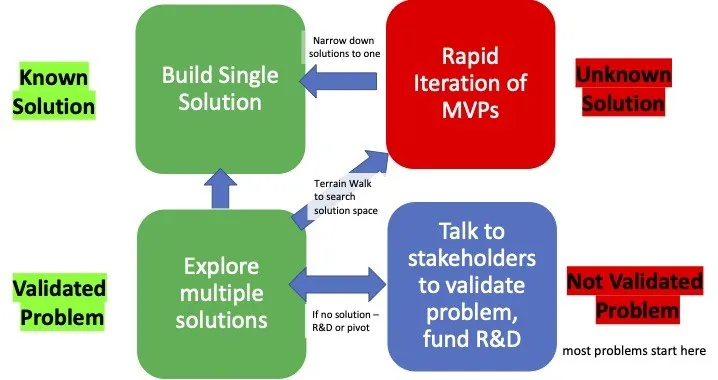
Steve Blank drew the map above for a Fortune 50 company fighting disruption. It asks two questions, in turn: is the problem validated? Is the solution known?
Most problems start in the bottom right box: they are not validated yet. Teams validate them with customer discovery, by talking to customers and stakeholders. Some problems need more R&D first.
Once a problem is validated, teams move to the bottom left box and explore several solutions.
If a known solution solves the problem, they go up to the top left box and build it.
Often, the solution is unknown. Teams first do what Blank calls a “technical terrain walk”: they describe the problem to vendors, internal developers and other internal programs, to find out whether a solution already exists. If none does, they head to the top right box and build minimum viable products (MVPs), the smallest set of features they can test with customers and partners. Then they narrow down to one solution.
The result: teams iterating fast to deliver what customers want and need, “within the limited time the company has left.”
Blank also points to a common mistake. When a strategy team hands down every problem as a fixed requirement, everyone assumes the problems are already validated. Teams no longer explore the problem themselves, and become extensions of the existing product development groups.
The traditional funnel is broken
“The traditional startup funnel is broken,” writes Ash Maurya in “In Search of Unicorns”.
Most innovation funnels in companies look like the traditional funnel he describes, with the same issues: too many ideas, ideas stuck before incubation, and no clear step-by-step process or metric to move the selected ones forward and turn them into businesses.
Why? Because the 12-week accelerator model doesn’t work
By Ash Maurya’s count, there were fewer than 50 startup accelerators in 2010, and more than 5,000 ten years later.
One of the problems: accelerators spend more time educating startups than accelerating them. Investors care about traction, founders care about their product, so programs fill the gap with courses on business modeling, lean startup, metrics, pitching and more.
A typical accelerator takes a batch of ten teams through three to four months, up to demo day. As Maurya puts it, “12 weeks is not enough time for education and acceleration.”
In companies as in accelerators, there are plenty of ideas. What’s missing is a clear step-by-step process, and a metric, to move the selected ones forward and turn them into businesses.
Sources: Steve Blank, A Simple Map for Innovation at Scale (steveblank.com, 2022), where the map above comes from, first published in an edited version by the BCG Henderson Institute (archived copy); Ash Maurya, In Search of Unicorns (2020).
See also: Can Big Corporations innovate better than Startups?, where Steve Blank and Alexander Osterwalder discuss corporate innovation, and The investment readiness level, Steve Blank’s way to judge startups at demo day on evidence rather than on slides.
An earlier version appeared in my newsletter on November 8, 2022.