Make faster decisions without taking bigger risks

As a company grows, its decisions slow down. More people to consult, more committees to convince. Nobody decides to become slow. The slowdown happens one meeting at a time.
Jeff Bezos saw the trap at Amazon and named the way out: sort decisions by whether you can undo them.
Why fast decisions win
A decision has no value when it is made. The value comes once the decision is executed and you see what happens. Until then, you only have a guess sitting in a slide deck.
Every decision starts a learning loop: you act, the market reacts, you adjust. Decide faster and you learn faster. Learn faster and you adapt faster. A team that decides in two days runs the loop ten times while another waits three weeks for a sign-off. After a year, the first team has seen ten times more real outcomes and learned from each one.
Each loop also shrinks the uncertainty.
- A slow organisation tries to remove uncertainty before acting, with studies and projections. But no study tells you whether customers will pay or a partner will deliver.
- A fast organisation uses action as its research method and finds out sooner what works and what doesn’t. Its direction gets clearer, and its odds of success go up.
Waiting has a cost too, and nobody puts that cost in the business case. While a decision sits in a queue, the window closes. A competitor ships first. The customer who asked for the feature buys elsewhere.
Bezos gives a yardstick in his 2016 letter to shareholders: most decisions should be made with around 70% of the information you wish you had. If you wait for 90%, you are probably being slow.
One-way doors, two-way doors
Deciding with 70% of the information means being wrong sometimes. Bezos accepted that: he called failure and invention “inseparable twins”. But a company only tolerates failure if most failures are cheap. So in his 2015 letter, he sorted decisions by whether you can walk back.
A few decisions are one-way doors: irreversible, so they deserve a slow, careful process. Most are two-way doors: if the choice proves wrong, you walk back through. Those should be made quickly, by one person or a small team.
You can get the type wrong in two ways, and the costs are not equal. Rushing a one-way door is rare, because everyone can see the stakes. Treating a two-way door like a one-way door looks like prudence, so nobody objects. The project waits for a committee, then a second opinion, then a business case built on projections nobody can verify. Repeat that for every small choice in a year, and the team loses its pace.
The decision matrix
Bezos’s split leaves a gap. Some decisions are irreversible but trivial, others reversible but expensive. George Strakhov’s matrix separates the two questions: reversibility on one axis, impact on the other. That gives four ways to decide.
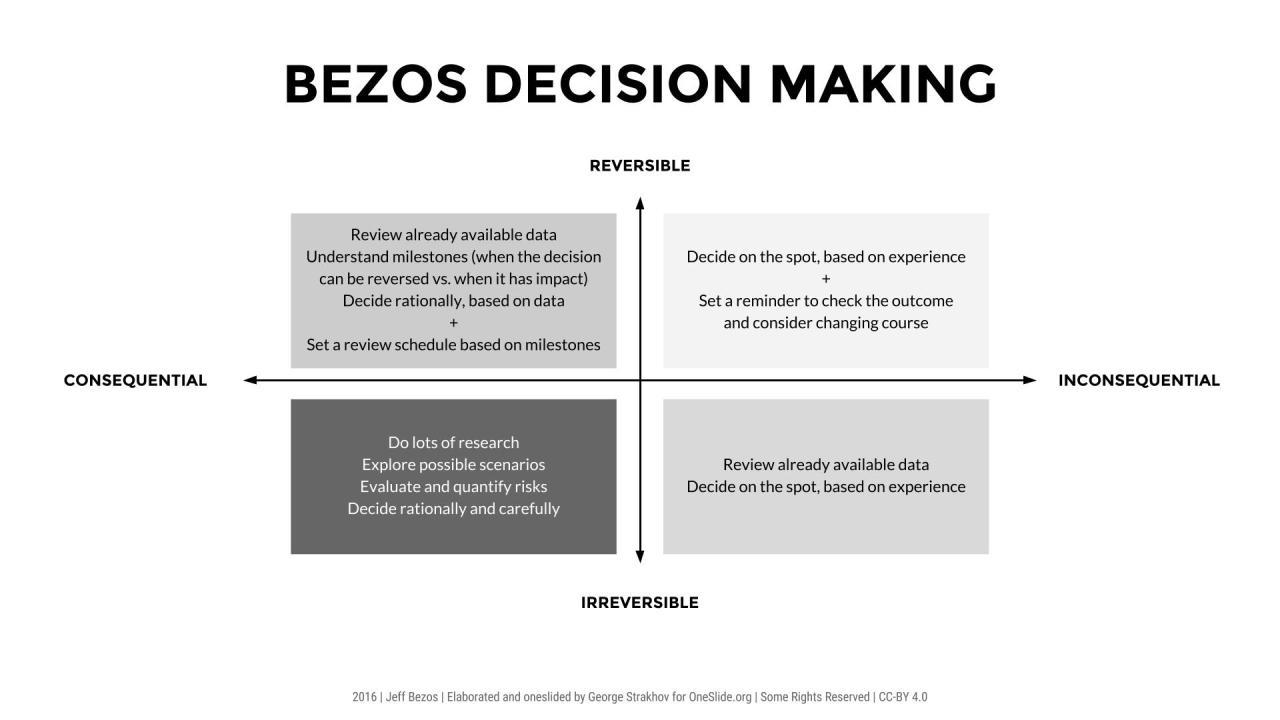
Bezos decision making, by George Strakhov for OneSlide.org (CC-BY 4.0).
Reversible and inconsequential
Small choices you can undo tomorrow. Decide on the spot, from experience. Set a reminder to check the outcome, and change course if needed. Most daily decisions live here, and this is where committees do the most damage.
Examples: changing the headline of a landing page, moving the weekly team meeting, trying a new tool on a free trial.
Irreversible but inconsequential
You cannot undo these decisions, but a mistake costs little. Check the data you already have, then decide on the spot. The stakes do not justify a new study.
Examples: printing 500 brochures for a trade show, sending the monthly newsletter, booking non-refundable train tickets for a client visit.
Reversible but consequential
You can walk back, but until you do, a wrong choice costs money or trust. Decide on the available data. Then map the milestones: until when the decision can still be reversed, and from when it starts to have an impact. Schedule a review at each milestone.
Examples: raising your prices, launching a pilot with your biggest customer, hiring a first salesperson with a trial period.
Irreversible and consequential
The true one-way door: no way back, and a mistake can weigh on the company for years. Research, explore scenarios, quantify the risks, decide carefully. Only this quadrant deserves the full process.
Examples: signing a five-year exclusive deal with a distributor, selling equity to an investor, closing a plant.
How to use the matrix with your team
When a discussion turns into a decision, classify the decision first. Can we reverse this choice? How much is at stake? Two questions, and you know which quadrant you are in.
Then protect the time. Any decision that is not both irreversible and consequential gets made fast: one named person or a small team, and a deadline counted in days. That is how the one-way doors get the time they need.
A team that decides most things fast can afford to go slow on the few decisions that deserve care. Try the two questions on the decisions already waiting for a meeting, a sign-off or more data. Most of them are two-way doors.
Turn one-way doors into two-way doors
Many decisions look like one-way doors only because the organisation built them that way: a budget you cannot hand back, a launch announced too early, a contract with no exit clause. Release the budget in tranches, run a pilot before announcing anything, and put an exit clause in the contract. To me, redesigning decisions this way is a big part of a corporate innovator’s job: each time, a decision moves to a quadrant where you can go fast.
Reversibility tells you whether you can walk back. The companion question is how much you can afford to lose if the bet fails: that is the affordable loss principle.