When AI structures and accelerates your innovation processes
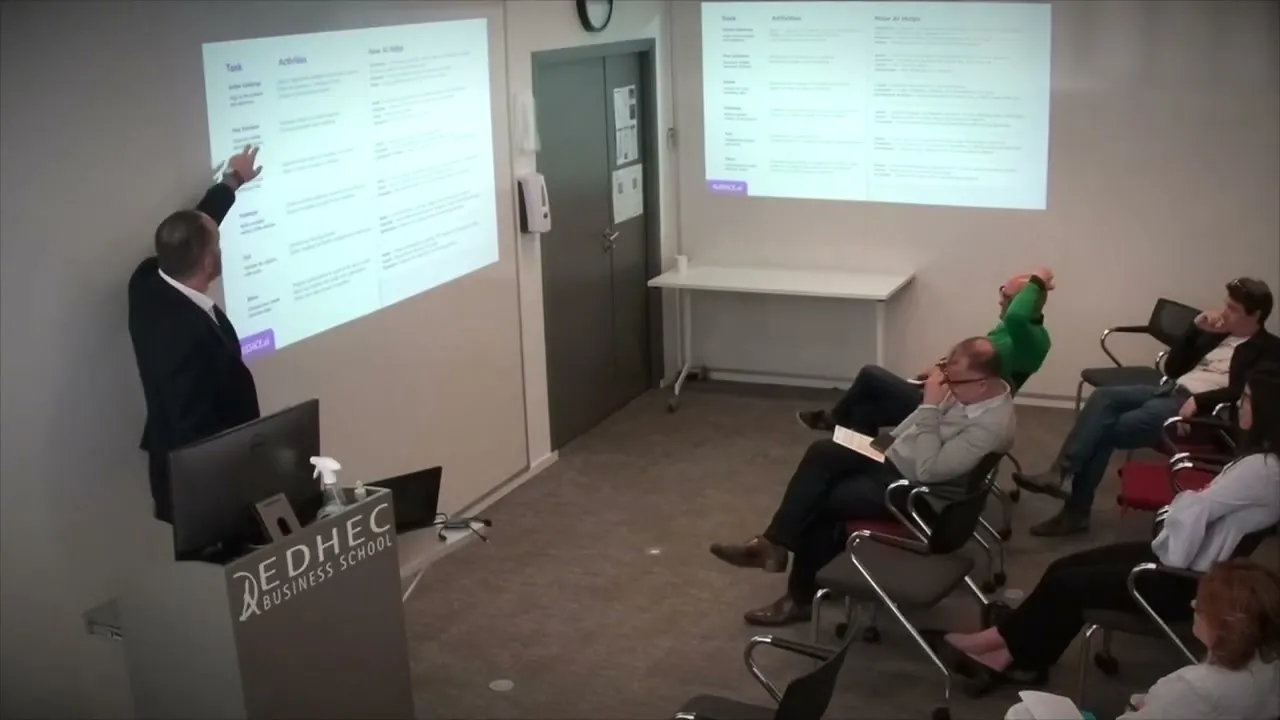
On 7 May 2025, at Lead Innovation Day, at EDHEC in Paris, I presented how artificial intelligence can structure and accelerate an innovation process.
I have been practising design thinking and lean startup since 2012. For the past two or three years, with the arrival of generative AI, I have been looking at these innovation processes and asking myself what it changes in them, and how to use it to innovate differently.
The problems of an innovation department
An innovation director has several missions: spotting the trends and technologies that will change their sector, encouraging an innovation culture, finding new sources of growth, and improving existing operations.
They also run into recurring problems: lots of ideas and not enough ways to filter them, ideas that must match real market demand, limited resources, choosing the right problems to work on, and alignment with the company strategy.
Their usual answers: acceleration programmes, open innovation with startups or universities, calls for ideas, consulting and coaching, hackathons and challenges, idea management platforms. These platforms often frustrate employees: they ask them for reporting instead of helping them.
Four roles for AI
In any process, AI can play four roles:
- Coach. It asks questions and challenges the person. Most people have the start of an idea, not a complete idea: "Have you thought about this? How would you do that?"
- Evaluator. Seen as an encyclopedia that is both very broad and very deep, it can place an idea against everything it knows about a sector, and give it a score.
- Maker. It produces what takes time: value propositions, texts, images, storyboards.
- Synthesiser. It absorbs your data, your customer interviews and your research, and gives you back the essentials when you need them.
A classic innovation process goes through a few steps: define a challenge, look for solutions, choose, prototype to make the idea tangible enough, test it with users, then communicate it internally so it gets taken into account. At each step, AI can play one of these roles.
The demo: a year of free charging
We had brought these roles together in a platform, Audace, designed for innovation departments that launch calls for ideas and receive lots of poorly formed ideas, to be studied one by one with feedback to each participant.
For the demo, I took a challenge inspired by Renault, selling more electric vehicles, and a deliberately vague idea: offer a year of free charging to every buyer.
- The coach AI asks to clarify the idea: for whom, what problem, how it works.
- It turns this into an idea sheet, with a title, the target, the problem, the value proposition and the solution, and can generate an image to illustrate it.
- It evaluates the description: 23 out of 50 on the first pass, including 2 out of 10 for the revenue model. Then it asks the missing questions.
- Once the idea is well described, it evaluates it on desirability, feasibility and viability, and names the riskiest assumption: do potential buyers really think a year of free charging lowers their costs?
- It suggests experiments, for discovery or validation, for example focus groups with potential buyers.
- Your own information counts. If your salespeople found that the offer closes one sale in two (a figure made up for the demo), the AI would take it into account, and a different assumption would become the riskiest.
- Agents play the sales director, the marketing director or the product director and give their opinion. Others, built on the fly, take the point of view of well-known leaders in the sector.
- To share the idea internally: a press release, like Amazon, which starts its projects that way, an elevator pitch, storyboards.
- Finally, a 90-day plan takes the risks and spreads the experiments over time.
What changes
The idea owner becomes autonomous: they work on their idea following a structured innovation process, at their own pace. And this process, diverge, choose, prototype, test, can take months or just a few hours.
The video is 24 minutes long. It is also on the Lead Innovation Day 2025 replays page.