I bootstrapped my business model. My MVP has traction with my early adopters!
In the guide Lean startup: where to start
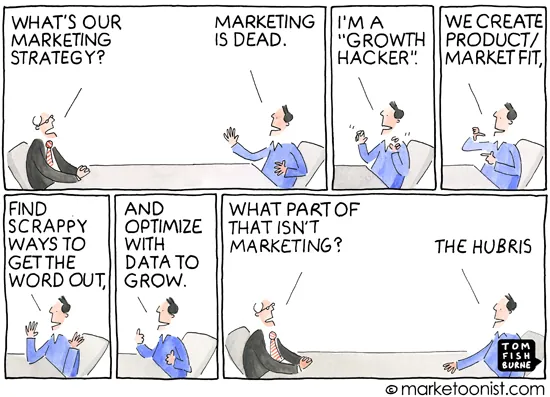
It’s because we pivoted to find our growth engine. And now it’s Product Market Fit!
…could you say that again?
Welcome to the world of Lean Startup, where people speak as much English as French… or rather Franglais. Acronyms, anglicisms, abbreviations: how do you find your way around?
What is Lean Startup?
“Lean Startup” is an entrepreneurial approach to creating a product or service. It relies on learning from the market, scientific experimentation and iterative design.
Building on the successes and failures of startups, Eric Ries gathered and codified several good practices that today form the basic methodology for designing startups, in his book “The Lean Startup”. In a few words, it means constantly adapting and adjusting your product as quickly as possible based on user feedback.
Or in jargon: you need to pivot on the value proposition of your business model with your early adopters to get traction and reach customer validation before building your MVP.
Clear? No!
OK, here is the decoder.
The decoder
Bootstrap: Starting a startup on limited own funds, without calling on outside investors. This pushes you to find creative solutions to make your idea happen. Having very few resources forces you to make choices and leads you to focus on what matters most to the customer.
Business Model : A business model describes how a company creates, delivers and captures value for its customers. Once its business model is laid out, the startup seeks to validate or invalidate it. Short experiments make it possible to test the different elements of the business model independently. If the experiments invalidate part of the business model, then you need to ask yourself whether to pivot.
Pivot: Pivoting means changing one element of your business model without changing your vision. For example, it can mean changing your target, your distribution channel or your solution without changing the other elements of your business model. A pivot is a change of strategy without a change of vision.

Early Adopter: Here, these are the people quickest to use your product or service. They are the ones who express most strongly the need or problem you are going to solve. Early adopters are your first target.
MVP : The most widespread Lean Startup term, but also the most confusing. The Minimum Viable Product is an experiment run with customers. This experiment is used to check whether you manage to meet the customer’s need, using a reduced version of the solution you plan to build.
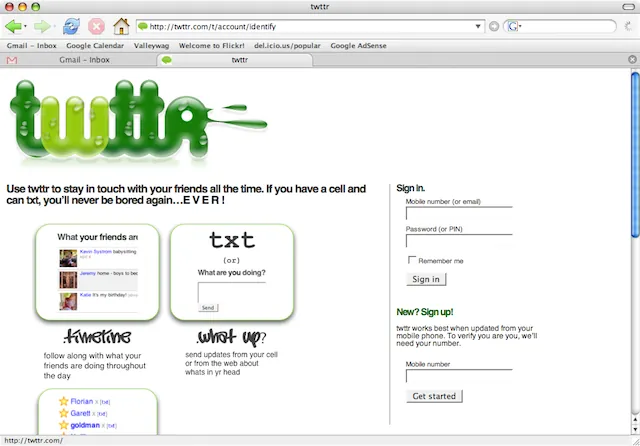
Traction: The company’s growth rate, the acquisition of new users or customers. It is a key indicator at the start for many B2C startups. Traction comes from your Growth Engine.
Growth Engine: The growth engine is the strategy put in place to grow the number of customers. There are three main strategies:
- By paying to acquire new customers, for example with a marketing campaign. This is the growth engine of many e-commerce sites, for example, which must constantly look for new customers through marketing campaigns.
- By being viral: this is when current customers’ use of the product prompts other people to use it. For example, social networks, where people sign up because their friends invited them.
- By improving retention: making sure customers stay over the medium to long term. For example, phone or other subscription services.
Product-Market Fit: The meeting and perfect match between a product and its market: the startup makes repeat sales. When there is product market fit, the startup can move to the growth phase, which is such that it cannot keep up with demand. This is also usually the point when other startups copy its concept.
Value Proposition: The value proposition is the simplest and most understandable wording that describes, precisely and in an actionable way, what you offer your customers. For example, Uber’s is “The Smartest Way to Get Around”. It must be clear to your future customers.
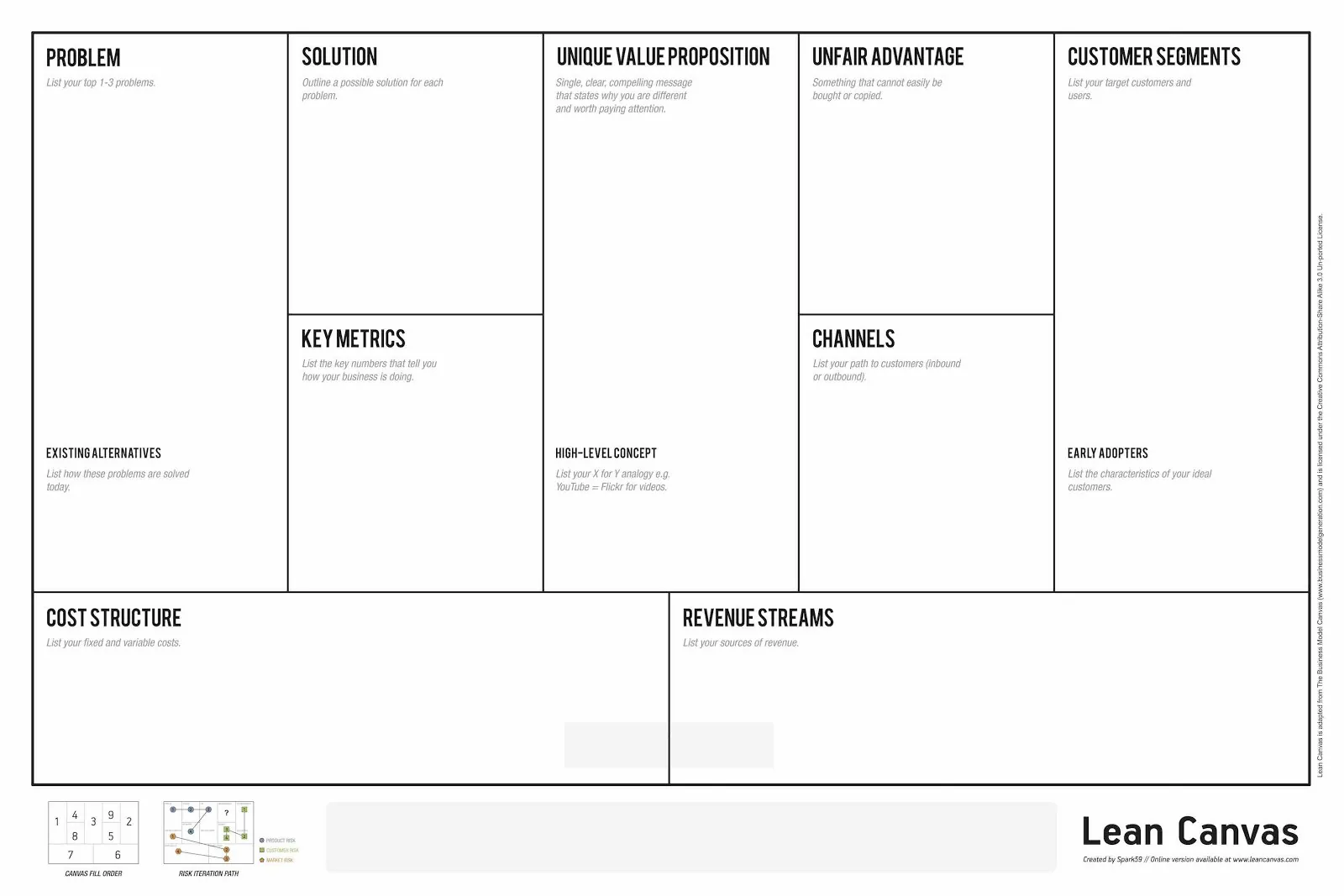
Lean Canvas: A chart summarising the different elements of your business model. It lets you put your hypotheses down on paper and use them as a working base to identify the elements to test.
Customer Validation: Even before building a product, it is essential to understand and validate your target customer and their needs. Steve Blank theorised this in what is called customer development. The validation phase consists of validating demand. (e.g. crowdfunding)
Bonus: bullshit bingo
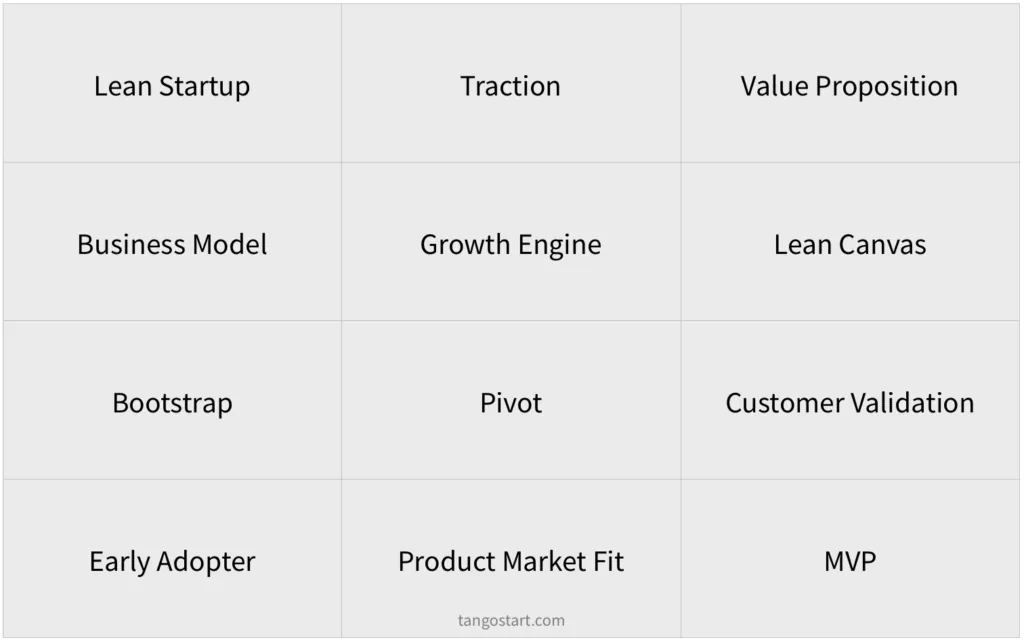
Now that you know the jargon, here is a little game to print and pull out at your next startup meeting! It’s Lean Startup bullshit bingo.
Each time a word is said, tick the matching box. When a row or a column is complete, shout “bullshit”. Well done! You’ve won!
I hope you found this useful, if not entertaining! And tell me if you won at Bingo!