The build trap: when shipping features becomes the goal
In short: The build trap is when a company measures success by what it ships, its outputs, instead of the value those features create, its outcomes. Teams are busy, releases go out on time, and the business barely moves. The way out: start from the change you want in customer behaviour, treat each feature as a bet you measure, use strategy as a framework for decisions, and make product managers answer for value. The idea comes from Melissa Perri’s book Escaping the Build Trap (O’Reilly, 2018).
Most product teams I meet are busy. Very few can tell me whether they are building the right things.
The roadmap is full until next year. Every sprint delivers. The release notes are long. And when you ask what changed for customers after the last release, the room goes quiet.
Melissa Perri has a name for this: the build trap.
What is the build trap?
A company is in the build trap when it judges itself by its outputs, the features and projects it delivers, instead of by its outcomes, the value those features create for customers and for the business.
An output is something the team ships: a new dashboard, an export to Excel, a mobile app. An outcome is a change in what people do: customers renew, onboarding takes one day instead of ten, support calls drop by a third. The output is the means. The outcome is the point.
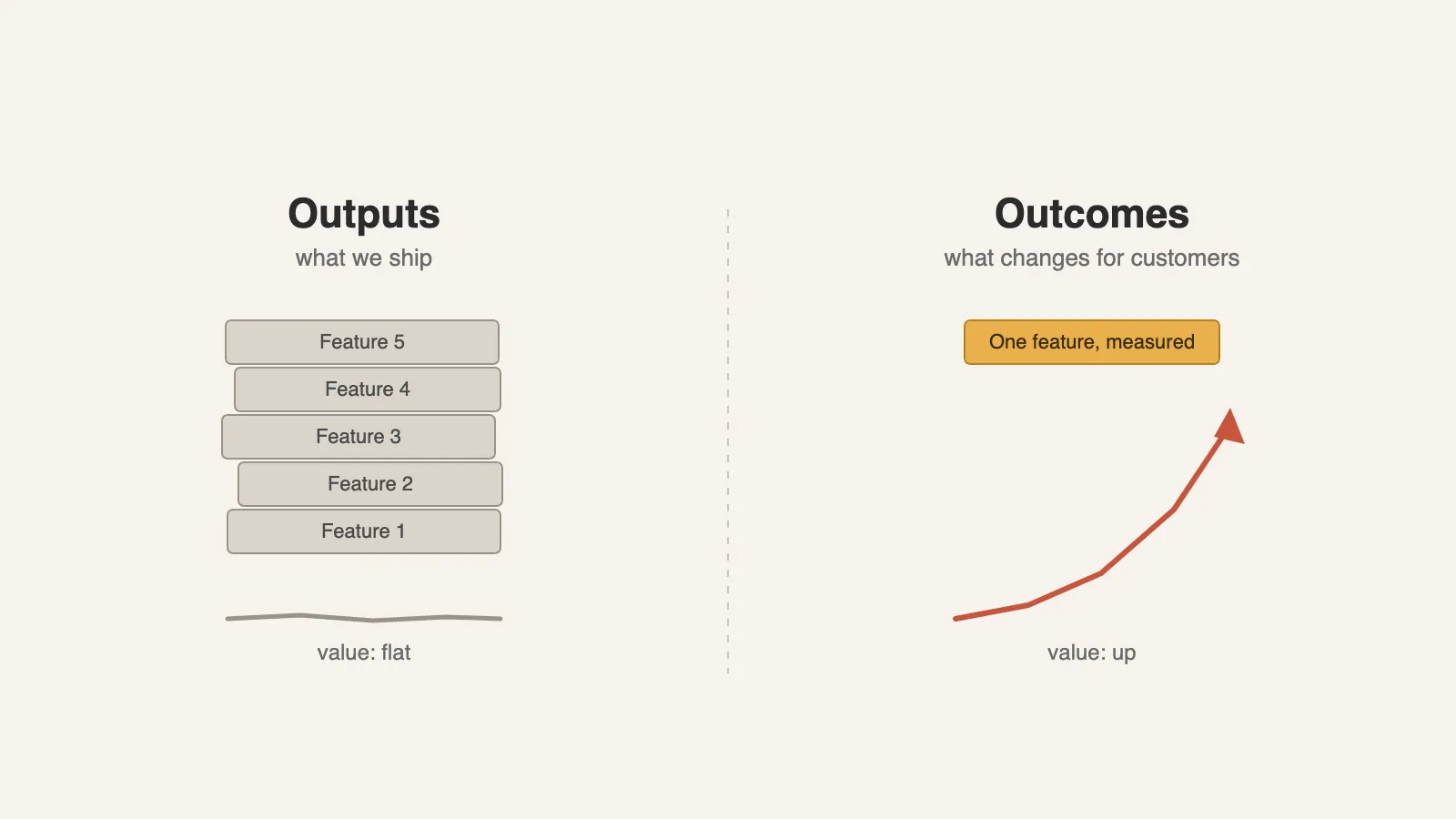
In the build trap, the means becomes the point. Everyone works hard, deadlines are met, and the numbers that matter stay flat.
How do you know you are in it?
Four signs come back again and again.
- Success is a release date. The team celebrates the launch, then moves on to the next feature. Nobody checks what changed for customers.
- The roadmap is a feature list. Features sit on a Gantt chart with dates, and the plan is to deliver them all. The question “why this feature?” has no written answer.
- Requests go straight to build. A key account, a salesperson or an executive asks for a feature, and the team builds it as asked. The request is a solution someone imagined; the problem behind it is never explored.
- Nothing is ever removed. The product only grows. Each feature looked small on its own, but together they make the product harder to learn, to use and to maintain. That is feature creep, and no feature is ever judged on its results.
If three of the four sound familiar, you are probably in the trap.
Why do companies fall into the build trap?
Because output is easy to see and easy to count. You can show a list of shipped features to a steering committee. You cannot show a change in customer behaviour that will take six months to appear, and may never appear.
Building also feels like progress. A team that writes code all week looks productive. A team that spends a week talking to customers and decides not to build looks idle, even if it just saved six months of work.
And saying yes feels safer than asking questions. When the biggest customer asks for a feature, building it is the path of least resistance. Questioning the request means a difficult conversation with sales, sometimes with the CEO.
The last cause is the deepest: no clear strategy. When nobody has decided what matters most, every team picks its own priorities. Effort spreads thin across dozens of initiatives. Everyone is busy, and nothing moves.
How do you get out of the build trap?
Aim for outcomes, not features
Start from the change you want: in customer behaviour, then in the business. Only then look for the smallest thing that could produce it. Sometimes it is a feature. Sometimes it is a change in pricing, in onboarding, in the sales pitch. Sometimes it is removing something.
Treat each feature as a bet. Before you build, write down how you will know it worked: which number should move, by how much, by when. After the launch, measure. Then fix, extend or stop. A feature that does not move its number is not a success because it shipped on time.
This is the same logic as an MVP: invest in proportion to the evidence. Little while you do not know, more as the evidence grows.
Use strategy to decide, not to plan
Building products is full of uncertainty. You cannot know in advance which features will work, so a strategy cannot be a fixed plan with dates.
Perri describes strategy as a framework for decisions, in layers. At the top, a vision of where the company wants to be in five to ten years. Below it, the business challenge that stands in the way. Then the product goals that address that challenge. At the bottom, the options the teams explore to reach those goals.
Leaders own the top layers: the direction and the guardrails. Teams own the bottom: they find out how to get there. When a request comes in, the question is no longer “can we fit it in?” but “does it serve the goal we chose?” Most requests fail that test, and that is the point.
Make product managers answer for value
In the build trap, product managers take orders and manage the backlog. They are judged on delivery: was it on time, was it on budget?
Out of the trap, the job changes. Product managers find the problems worth solving, talk to customers, test solutions before the build, and answer for the result. They say no more often than yes.
That shift needs the strategy above. A product manager cannot say no to a key account without a goal to point to. And leaders will only give teams room to experiment if they trust that the teams are aligned on what matters.
Where to start on Monday
Take the five features at the top of your roadmap. For each one, write one sentence: which customer behaviour should change, and how you will measure it.
The features where you cannot write that sentence are your build trap. Before you build them, find the problem behind the request.
Further reading
- Melissa Perri, Escaping the Build Trap: How Effective Product Management Creates Real Value, O’Reilly, 2018. The book goes much further than this note, on strategy, on the product manager role and on the organisation around it. Cover image: O’Reilly Media.
- Kano framework, classification of user needs: not every feature creates the same value.
- How to decide on strategic projects: why ROI is not enough.
- The one metric you need to track: choosing the number a feature should move.
- The product management guide on this blog.