Applying the Lean Startup principles to game development
In the guide From code to product
A few months ago, I started exploring how the Lean Startup principles could be applied to computer game development.
This journey led me to Alexandre Normand, co-founder of Execution Labs, an accelerator for game developers inspired by the Lean Startup approach. Alexandre started Execution Labs to help independent game developers produce the games they want to build.
In the past years as games shifted from being standalone products to becoming evolving services, the upfront paid model faded to give birth to the free-to-play model.
This shift made continuous improvement of computer games possible.
So how does Execution Labs apply Lean Startup to game development?
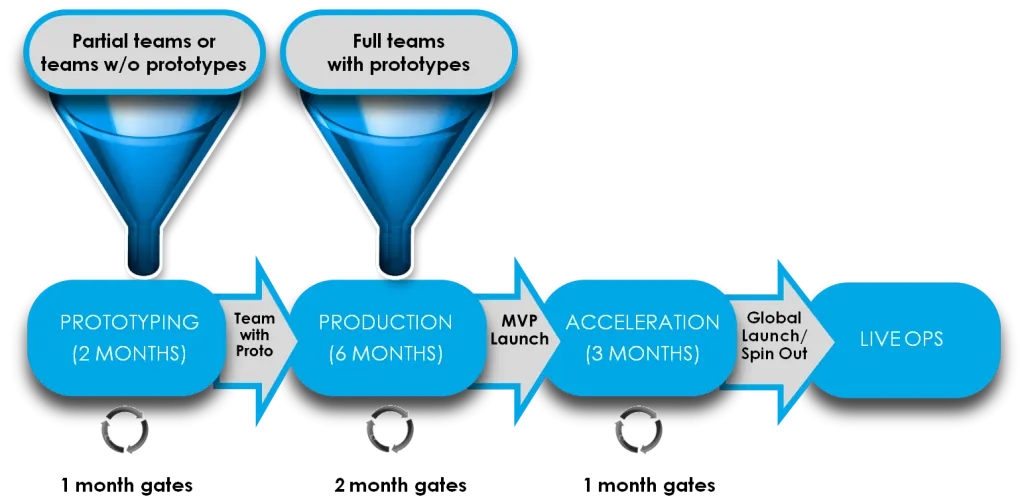
Build the MVP/v0 in 6 months
As the goal is to create player engagement, it’s important that the design and visuals are pretty and pleasant enough. To go faster, don’t reduce or compromise the quality of the graphics, but rather reduce the amount or variety of graphics produced.
Fixing the development time to 6 months forces you to focus on what really matters for the game to be good. Some games are tested early with paper prototypes.
Continuous and regular customer feedback
Test the game every other week with 10 to 15 players. Regularly, players come to the Execution Lab to play with the prototypes. This provides the game developers with precious qualitative feedback, on top of the quantitative tracking already in place.
Limited launch on test markets
Launch the v0 on test markets, similar enough to your target markets but with a smaller population – typically Canada, NZ, AUS or Finland.
Meta-game comes later
The initial focus is on the core loop. The goal is to test and iterate so the core becomes fun and engaging. The meta game comes later. The meta game will ensure the longer-term retention and repeated play.
Alexandre confirmed that to build a game, programming is the most time-consuming activity, followed by graphic design and game design.
So as far as reducing waste, programming should be the place to look next.
Here is the Execution Lab process.