Product/market fit starts with your high-expectation customers
In the guide Value proposition and pricing
Finding early adopters is a big deal when you start a business. It really shouldn’t be.
Push or pull: where to find your early adopters
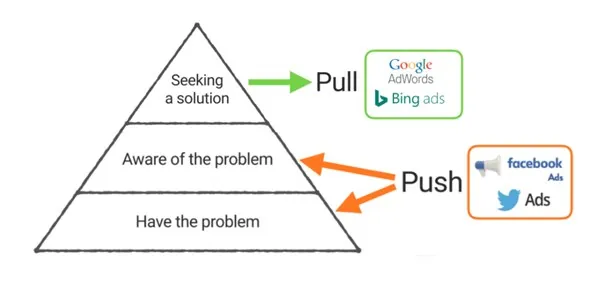
David Bland shares a simple method, push versus pull customer acquisition, summed up in the diagram above.
- Pull. Some people are actively looking for a solution. They search for it, so search ads (Google, Bing) are where you meet them.
- Push. Others have the problem, and may even be aware of it, but are not looking for a solution. You have to bring your offer to them, with ads on social networks (Facebook, Twitter).
Search or social ads, a good landing page, a little bit of resilience, and you should catch your early adopters.
Then go offline and interview them.
Superhuman’s engine for product/market fit
Achieving product/market fit is the holy grail for most startups. Rahul Vohra, the founder of Superhuman, turned it into a process he could run again and again:
- Measure. Ask your users one question: “How would you feel if you could no longer use the product?” Very disappointed, somewhat disappointed, or not disappointed. The benchmark comes from Sean Ellis: when at least 40% of users would be very disappointed, you have product/market fit. Superhuman started at 22%.
- Segment. Find your supporters, the users who would be very disappointed, and focus on your high-expectation customers. Politely disregard those who would not be disappointed without your product.
- Analyze the feedback. Understand what your fans love, and what holds back the users who are on the fence.
- Rework the roadmap. Split it between doubling down on what users love and fixing what holds the others back.
- Repeat, and keep tracking the score. Superhuman went from 22% to 58%.
The high-expectation customer
A sure way to please no one is to try to please everyone.
Julie Supan helped Airbnb, Dropbox and Thumbtack craft their positioning before they launched. Her advice: don’t go after every possible user. Focus on your high-expectation customer (HXC), the most discerning person in your target market, the one who will recognize and enjoy the greatest benefit of your product. With limited resources, a lack of focus drains your processes and your team’s morale.
For Dropbox, the HXC was organized and tech-savvy, and wanted to simplify their life and save time. For Airbnb, it was the traveler who wanted to live like a local.
It is no coincidence that Superhuman’s engine relies on the same idea: Rahul Vohra credits Julie Supan’s high-expectation customer.
Do you know who your ideal users are, the ones who really care?
Sources: David Bland, How Do I Find My Early Adopters? (Precoil, 2020), where the diagram comes from; Rahul Vohra, How Superhuman Built an Engine to Find Product/Market Fit (First Round Review, 2018); Julie Supan, What I Learned From Developing Branding for Airbnb, Dropbox and Thumbtack (First Round Review, 2016).
See also: Finding your early adopters: how to fall in love, and my test of the Superhuman app, J’ai testé Superhuman (in French).
An earlier version appeared in my newsletter on May 7, 2021.